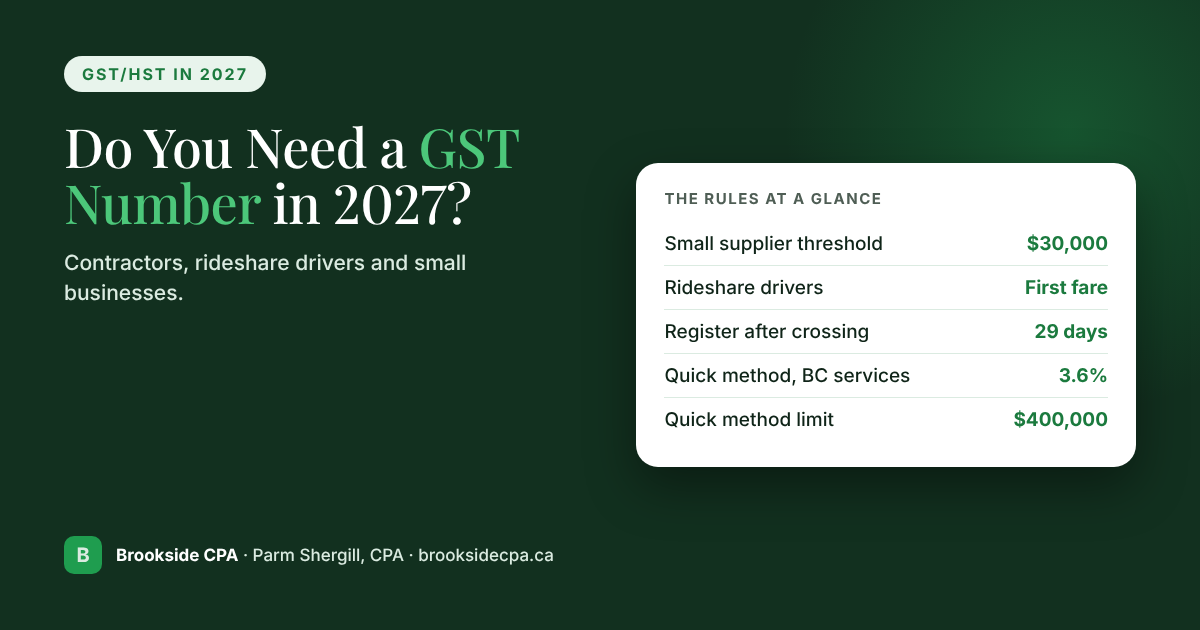
Do you need a GST number in 2027? The $30,000 rule, why Uber drivers register from day one, how to get a GST number in BC, the quick method and deadlines.
GST/HST in 2027
By Parm Shergill, CPA · Brookside CPA · Updated November 25, 2026 · 9 min read
Quick answer: You must register for GST/HST once your taxable sales pass $30,000 in a single calendar quarter or over four consecutive calendar quarters. Uber, Lyft and taxi drivers must register before their first ride, no matter how much they earn. Below the threshold, registering is optional.
"Do I need a GST number?" is one of the first questions new contractors, drivers and small business owners ask us, and one of the most expensive to get wrong. One of the most common GST/HST problems is not fraud. It is people who pass the $30,000 threshold without noticing, never charge GST/HST, and then owe it out of their own pocket years later.
Here is how GST/HST registration works heading into 2027, the special rules for rideshare drivers, and the choices that affect how much you remit.
The $30,000 small supplier threshold
You are a small supplier, and do not have to register, as long as your total taxable revenue is $30,000 or less:
in any single calendar quarter, and
over the last four consecutive calendar quarters.
The $30,000 includes revenue from associated businesses, and it is based on revenue before expenses, not profit. It includes zero-rated sales but not exempt ones. The threshold has not changed for 2027.
When you have to start charging GST/HST
The rule depends on how you cross the line:
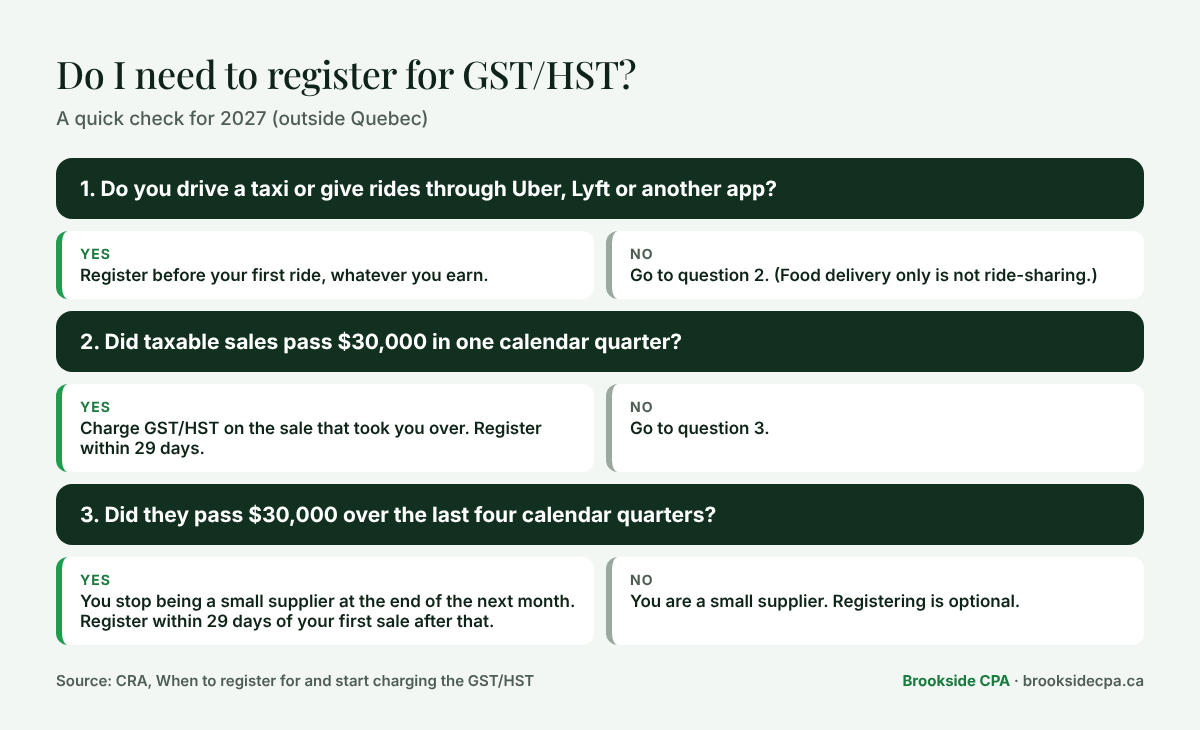
Over $30,000 in a single quarter: you stop being a small supplier immediately. You must charge GST/HST on the sale that took you over and register within 29 days.
Over $30,000 across four quarters (but not in one quarter): you stop being a small supplier at the end of the month after the quarter in which you crossed. You must charge GST/HST starting with your first taxable sale after that date, and register within 29 days of that sale.
Many growing businesses cross the threshold gradually without checking. If you are close, review your revenue at the end of every quarter, not just at tax time.
Do you need to register? A three-question check.
Rideshare drivers: register from your first fare
The small supplier rule does not apply to taxi and commercial ride-sharing drivers. The CRA treats anyone who drives passengers for a fee through an app like Uber or Lyft as carrying on a taxi business for GST/HST purposes. That means:
You must register for GST/HST before your first ride, even if you earn far less than $30,000.
You must charge and collect GST/HST on your fares. A ride-sharing company you authorize can handle some of this for you, but you remain responsible for filing returns and remitting the net tax.
You can claim input tax credits (ITCs) for the GST/HST you pay on business costs, such as the business portion of fuel, maintenance and phone bills.
Food delivery is different
Delivering food or parcels through apps like Uber Eats, DoorDash or SkipTheDishes is not ride-sharing. If you only do delivery, the normal $30,000 small supplier rule applies. If you do both rides and delivery, you must be registered because of the rides, and you need to apply GST/HST correctly to each type of income.
Platforms now report your income to the CRA
Since the 2024 calendar year, digital platform operators must report information about their sellers, including rideshare and delivery drivers, to the CRA each year by January 31. The CRA uses that data to match against your tax and GST/HST returns, so unreported app income is much easier for the CRA to find than it used to be.
Contractors, trades and other service businesses
For most contractors, realtors, truckers and consultants, the $30,000 test is what matters. A few points come up often in our trades and contractors practice:
Register before you start a big contract if you know you will pass $30,000. You cannot easily add GST/HST to an invoice after the client has paid.
Check your GST/HST rate by where you supply, not where you live. Rates include 5% GST in BC, Alberta and other GST-only provinces, 13% HST in Ontario, 14% in Nova Scotia, and 15% in New Brunswick, Newfoundland and Labrador, and Prince Edward Island.
BC PST is separate. BC contractors often deal with provincial sales tax on materials. It is a different system administered by the province.
Thinking about incorporating? A new corporation needs its own GST/HST account. Our guide to incorporating in 2027 covers the timing.
Keep valid invoices. To claim ITCs, your supplier invoices need the supplier's GST/HST number and other required details.
Should you register voluntarily?
You can register even if you earn less than $30,000. It often makes sense if:
your customers are mostly GST/HST-registered businesses, who can claim back the tax you charge;
you have significant start-up costs, because you can claim ITCs on the GST/HST you pay; or
you expect to cross the threshold soon and want to avoid a mid-contract change.
If most of your customers are consumers, registering early may simply make you more expensive. Once registered, you generally must stay registered for at least one year before you can cancel.
Filing frequency and 2027 deadlines
New registrants with $1.5 million or less in annual taxable sales are usually assigned annual filing, but can choose quarterly or monthly. Many small businesses choose quarterly so the tax owed never builds up into one large bill.
Monthly and quarterly filers: file and pay one month after each period ends.
Annual filers who are individuals with a December 31 year-end: file by June 15, 2027, and pay by April 30, 2027.
Other annual filers: file and pay three months after year-end.
All registrants, except charities and certain financial institutions, must file GST/HST returns electronically. For every other 2027 date, see our CRA tax deadlines 2027 calendar.
The quick method: simpler, and sometimes cheaper
If your annual taxable sales (including GST/HST) are $400,000 or less (tested over four of your last five fiscal quarters), you may be able to use the quick method. Instead of tracking every ITC, you remit a set percentage of your GST-included sales. You still claim ITCs on capital purchases like vehicles and equipment.
For businesses in BC and other GST-only provinces:
3.6% for most service businesses
1.8% if your purchases of goods for resale (including GST/HST) are at least 40% of your taxable sales
a 1% credit on the first $30,000 of eligible sales each year
The quick method usually helps businesses with low taxable expenses, such as consultants and some trades who invoice mostly labour. It often does not help rideshare drivers with high fuel and vehicle costs. Compare both methods with real numbers before electing.
What it costs to get it wrong
If you should have registered and did not, the CRA can assess the GST/HST you should have charged, even if you never collected it, plus interest and penalties. Budget 2026 also proposes to raise many fixed-dollar penalties under the Excise Tax Act for reporting periods ending after 2027, and to let the CRA report large unpaid tax debts, including GST/HST debts over $50,000, to credit bureaus. Both are proposals and not yet law.
GST/HST you collect is held in trust for the government. If it is not remitted, the CRA can pursue it aggressively. Our pages on CRA trust accounts examinations and CRA audit help explain what happens when the CRA reviews a file.
How to get a GST/HST number in BC (and the rest of Canada)
Getting a GST number is free and usually takes one session online. The steps are the same in BC and every other province except Quebec, where Revenu Québec administers the GST/QST.
Get a business number (BN) if you do not have one.
Register for a GST/HST program account (RT) online through the CRA's Business Registration Online service, or with your accountant's help.
Choose your effective date carefully. It should match the day you were required to start charging tax, or the day you want voluntary registration to begin.
Set up your bookkeeping so GST/HST collected and paid is tracked separately from day one.
How Brookside CPA can help
We register clients for GST/HST, choose the best filing method, file returns on time, and fix past years when someone registered late. Parm's experience as a former CRA GST/HST auditor means we know what the CRA looks for in a GST/HST review. Check your risk with our CRA audit risk tool, or book a free call.
Frequently asked questions
Do I need to register for GST/HST in 2027?
You must register once your total taxable revenue (including associated businesses) is more than $30,000 in a single calendar quarter or over the last four consecutive calendar quarters. Taxi and commercial rideshare drivers must register from their first fare, no matter how much they earn. You can also register voluntarily below the threshold.
Do I need to register for GST as an Uber driver?
Yes. The CRA treats commercial ride-sharing like a taxi business, so rideshare drivers must register for GST/HST before they start giving rides, even if they earn less than $30,000. Food delivery through apps like Uber Eats or DoorDash is not ride-sharing, so the normal $30,000 small supplier rule applies to delivery-only income.
How long do I have to register after passing $30,000?
If you go over $30,000 in a single calendar quarter, you must charge GST/HST on the sale that took you over and register within 29 days. If you go over across four quarters, you stop being a small supplier at the end of the month after that quarter, and you must register within 29 days of the day you start charging tax.
What is the GST quick method in BC?
The quick method lets eligible small businesses remit a set percentage of their GST-included sales instead of tracking every input tax credit. In BC and other GST-only provinces, the rate is 3.6% for most service businesses and 1.8% for businesses whose purchases of goods for resale are at least 40% of their taxable sales, with a 1% credit on the first $30,000 of eligible sales each year. Annual taxable sales must be $400,000 or less.
When is my GST/HST return due in 2027?
Quarterly and monthly filers file and pay one month after each period ends. Annual filers who are individuals with business income and a December 31 year-end file by June 15, 2027 but must pay by April 30, 2027. Other annual filers file and pay three months after year-end.
How do I get a GST number in BC?
Get a business number from the CRA if you do not have one, then register for a GST/HST program account (RT) through the CRA's Business Registration Online service, by phone, or through your accountant. There is no fee. Choose an effective date that matches the day you were required to start charging tax, or the day you want voluntary registration to begin.
Brookside CPA is led by Parm Shergill, CPA, who spent about ten years in CRA's audit division. We handle bookkeeping, T1 and T2 returns, GST/HST, payroll and CRA matters for small businesses, contractors, truckers, rideshare drivers, realtors and incorporated owners across Canada. Book a free consultation and get answers for your situation.
How this guide was prepared: written by Parm Shergill, CPA, with every figure, date and rate checked against the CRA, Department of Finance, Canada Gazette and Province of BC sources listed below on November 25, 2026. Items marked proposed or projected are not yet law or not yet confirmed by the CRA.
This article is general information for Canadian taxpayers, current as of November 25, 2026. It is not tax advice for your situation. Figures marked proposed or projected can change before they become law or are confirmed by the CRA.
The budgeting myths that leave Canadian owners short of cash, plus a practical 2027 rhythm: a rolling budget, a 13-week cash forecast, and a tax set-aside.