
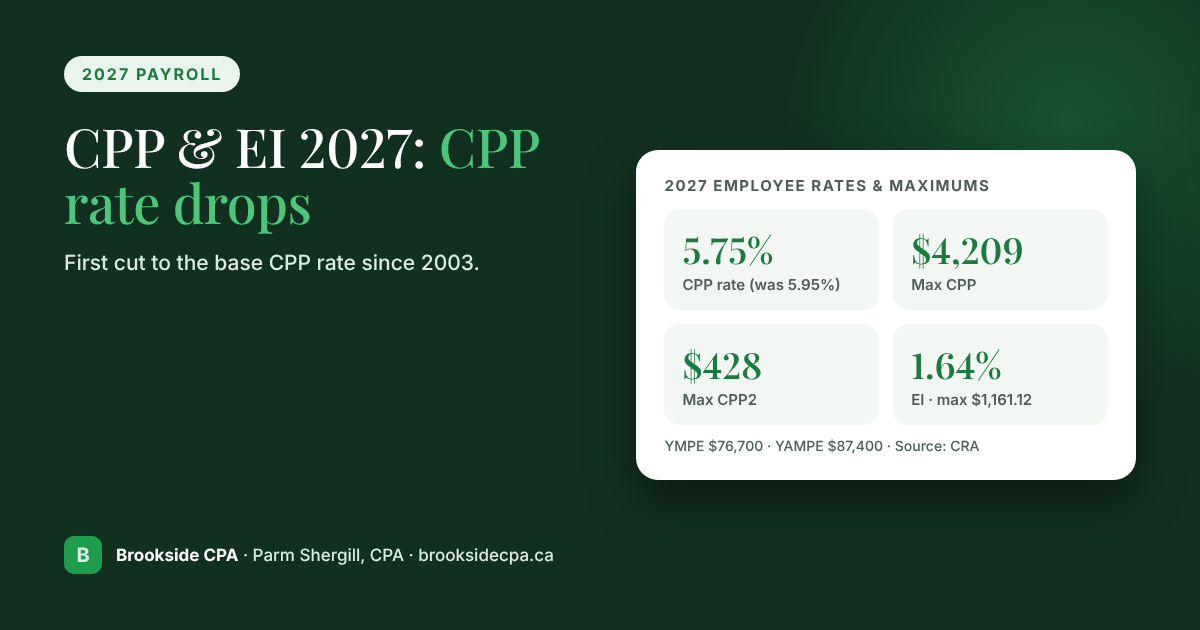
Quick answer: The CPP max for 2027 is $4,209 each for employees and employers ($8,418 if self-employed), at a rate of 5.75%, down from 5.95%. CPP2 adds up to $428 ($856 self-employed). The EI max is $1,161.12, at 1.64% on insurable earnings up to $70,800.
For years, payroll costs only went one way. In 2027 that changes. The base Canada Pension Plan (CPP) rate is going down on January 1, 2027, the first change to the base rate since it reached 9.9% in 2003. At the same time, the earnings ceilings for CPP and EI are going up, and the EI rate moves up by one cent per $100.
If you run payroll, pay yourself a salary from your corporation, or file as a self-employed contractor, here are the confirmed 2027 numbers and what they mean in dollars.
Is CPP going up or down in 2027? Yes, here is what changed
The federal government announced the cut in the Spring Economic Update on April 28, 2026. Parliament passed it as part of Bill C-30, and an order in council published in the Canada Gazette in November 2026 brought it into force.
- The base CPP rate drops from 9.9% to 9.5% of pensionable earnings.
- For employees and employers, that is 4.75% each instead of 4.95%.
- The first additional CPP rate (1% each) and the CPP2 rate (4% each) do not change.
- Self-employed people pay both halves, so their total rate on earnings up to the YMPE falls from 11.9% to 11.5%. (Income tax brackets for 2027 are in our 2027 tax brackets guide.)
Finance Canada estimates an employee earning $70,000 saves about $133 a year, and so does their employer.
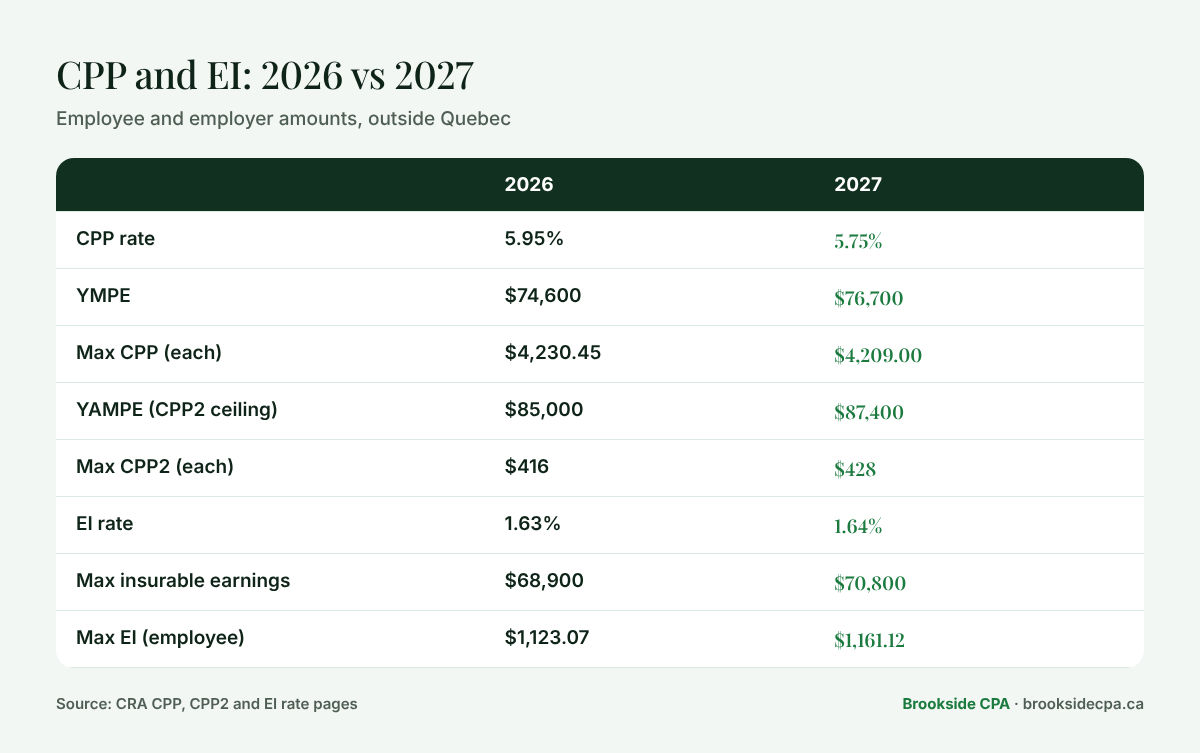
2027 CPP rates, maximums and YMPE
| 2026 | 2027 | |
|---|---|---|
| Maximum pensionable earnings (YMPE) | $74,600 | $76,700 |
| Basic exemption | $3,500 | $3,500 |
| Maximum contributory earnings | $71,100 | $73,200 |
| Employee and employer rate | 5.95% | 5.75% |
| Maximum employee and employer contribution | $4,230.45 | $4,209.00 |
| Maximum self-employed contribution | $8,460.90 | $8,418.00 |
Source: CRA, CPP contribution rates, maximums and exemptions (2027 row marked "New 2027").
Notice that the 2027 maximum is only $21.45 lower than 2026, even though the rate dropped. That is because the YMPE rose by $2,100. On the same $73,200 of contributory earnings, the rate cut alone saves $146.40 each for the employee and the employer.
CPP2 maximum contribution in 2027
The second additional CPP applies to earnings between the YMPE and a higher ceiling, the YAMPE.
| 2026 | 2027 | |
|---|---|---|
| Additional maximum pensionable earnings (YAMPE) | $85,000 | $87,400 |
| CPP2 rate (employee and employer) | 4% | 4% |
| Maximum employee and employer CPP2 | $416 | $428 |
| Maximum self-employed CPP2 | $832 | $856 |
Source: CRA, CPP2 contribution rates and maximums.
Put together, the most an employee can pay in CPP and CPP2 in 2027 is $4,637, and the most a self-employed person can pay is $9,274.
EI rates for 2027
| 2026 | 2027 | |
|---|---|---|
| Maximum insurable earnings | $68,900 | $70,800 |
| Employee rate (outside Quebec) | 1.63% | 1.64% |
| Maximum employee premium | $1,123.07 | $1,161.12 |
| Maximum employer premium (1.4x) | $1,572.30 | $1,625.57 |
Sources: CRA, EI premium rates and maximums; ESDC news release, September 14, 2026. Quebec has lower EI rates because of the Quebec Parental Insurance Plan.
What it costs to employ someone in 2027
For an employee earning $87,400 or more in 2027, the employer's maximum share of CPP, CPP2 and EI is:
- CPP: $4,209.00
- CPP2: $428.00
- EI: $1,625.57
- Total: $6,262.57 per employee, before provincial health levies or WorkSafeBC premiums
For a team of ten people earning about $70,000 each, the CPP cut alone saves the business roughly $1,330 a year, based on Finance Canada's estimate. That is not a reason to hire, but it is worth knowing when you set your 2027 budget.
Self-employed CPP in 2027
If you are a sole proprietor, contractor, trucker, realtor or rideshare driver, you pay CPP on your net self-employment income when you file your return. You pay both the employee and employer shares.
- The maximum for 2027 is $8,418 for CPP, plus up to $856 for CPP2.
- Part of what you pay is a deduction and part is a non-refundable tax credit, so the true cost is lower than the headline amount.
- You do not pay EI on self-employment income unless you opt in to EI special benefits.
Because you pay both halves, the self-employed see about twice the saving from the 2027 rate cut. For someone with $70,000 of net self-employment income, that is about $266.
Salary vs dividends in 2027: does the CPP cut change anything?
If you own a corporation, you choose how to pay yourself: salary, dividends or a mix. CPP is one of the main differences between the two.
Salary
- Attracts CPP (both your share and your corporation's share). In 2027, that is up to $9,274 combined at the top.
- Creates RRSP room: 18% of earned income. To earn the full $36,390 RRSP limit for 2028, you would need about $202,167 of 2027 earned income.
- Builds your CPP retirement pension.
- Is deductible to the corporation.
- Is usually not subject to EI if you control more than 40% of the voting shares.
Dividends
- No CPP and no EI.
- No RRSP room.
- Taxed at personal dividend rates, after the corporation has paid tax.
The 2027 cut makes salary slightly cheaper than it was, but the change is small. The bigger questions are still how much cash you need personally, whether you want RRSP room and CPP benefits, and whether you have family members who work in the business. Run your own numbers with our salary vs dividend calculator, then talk to us before you set your 2027 pay. Not incorporated yet? Start with should I incorporate my business in 2027.

Your 2027 payroll checklist
- Confirm your payroll software has loaded the 2027 tables for CPP, CPP2, EI and income tax. Run a test pay before your first January payroll.
- Reset year-to-date maximums. CPP and EI start again from zero on January 1.
- Check owner-employee settings. If you own more than 40% of the voting shares, make sure EI is not being deducted from your salary.
- Remit on time. Most small employers remit source deductions by the 15th of the following month. Late remittances carry penalties.
- File 2026 T4 slips by March 1, 2027, because February 28 falls on a Sunday. Every other date is in our 2027 CRA deadline calendar.
- Budget for 2027 with real numbers. Use the employer cost above when you plan raises, new hires or your own salary.
Note: CPP contributions vs CPP benefits
This guide covers what you pay in. If you searched for the maximum CPP retirement payment in 2027 or CPP payment dates, those are set by Service Canada, not the CRA, and are separate from contribution rates.
How Brookside CPA can help
We run payroll, file T4s and remittances, and plan owner pay for incorporated clients across Canada. Parm's background as a controller and CFO means we look at payroll as part of your whole cash flow, not just a compliance task. See our bookkeeping and payroll services or book a free call to review your 2027 pay plan.
Frequently asked questions
What is the CPP max for 2027?
For 2027, the maximum CPP contribution is $4,209 each for employees and employers, and $8,418 for self-employed people. On top of that, the second additional CPP (CPP2) maximum is $428 each for employees and employers, or $856 if you are self-employed.
Is CPP going up or down in 2027?
Down. The base CPP contribution rate drops from 9.9% to 9.5% on January 1, 2027, although the maximum pensionable earnings (YMPE) go up. Employees and employers each pay 5.75% in total (4.75% base plus 1% first additional) instead of 5.95%. The change was passed in the Spring Economic Update 2026 Implementation Act and brought into force by order in council.
What are the EI rates for 2027?
The 2027 EI premium rate is 1.64% of insurable earnings for employees outside Quebec, up from 1.63%. Maximum insurable earnings rise to $70,800, so the maximum employee premium is $1,161.12. Employers pay 1.4 times the employee amount, up to $1,625.57 per employee.
Do incorporated business owners pay EI?
Generally, if you control more than 40% of the voting shares of the corporation that employs you, your employment is not insurable and EI premiums are not deducted from your salary. CPP still applies to salary. Dividends do not attract CPP or EI.
How much will I save from the 2027 CPP cut?
Finance Canada estimates an employee earning $70,000 saves about $133 a year, with matching savings for the employer. A self-employed person earning the same amount pays both halves, so the saving is about $266.
What is the YMPE for 2027?
The year's maximum pensionable earnings (YMPE) for 2027 is $76,700, up from $74,600 in 2026. The year's additional maximum pensionable earnings (YAMPE), the ceiling for CPP2, is $87,400.
Talk to a CPA before the 2027 filing season
Brookside CPA is led by Parm Shergill, CPA, who spent about ten years in CRA's audit division. We handle bookkeeping, T1 and T2 returns, GST/HST, payroll and CRA matters for small businesses, contractors, truckers, rideshare drivers, realtors and incorporated owners across Canada. Book a free consultation and get answers for your situation.
Book a free consultation- 📞 Phone: 778-551-2532
- ✉️ Email: info@brooksidecpa.ca
- 📅 Free consultation: Book a free 30-minute call
- 🌐 Website: brooksidecpa.ca
How this guide was prepared: written by Parm Shergill, CPA, with every figure, date and rate checked against the CRA, Department of Finance, Canada Gazette and Province of BC sources listed below on November 25, 2026. Items marked proposed or projected are not yet law or not yet confirmed by the CRA.